Knife is an unusual read. In part, a harrowing and emotional retelling of the attempted murder of its author, Salman Rushdie. In part, a love letter to Rushdie’s fifth wife, Rachel Eliza Griffiths. But it’s also an opportunity for him to show off his intellect, name-drop voraciously, and share how well-regarded he now is. The latter is perhaps fair enough after the years he spent being hated by millions.
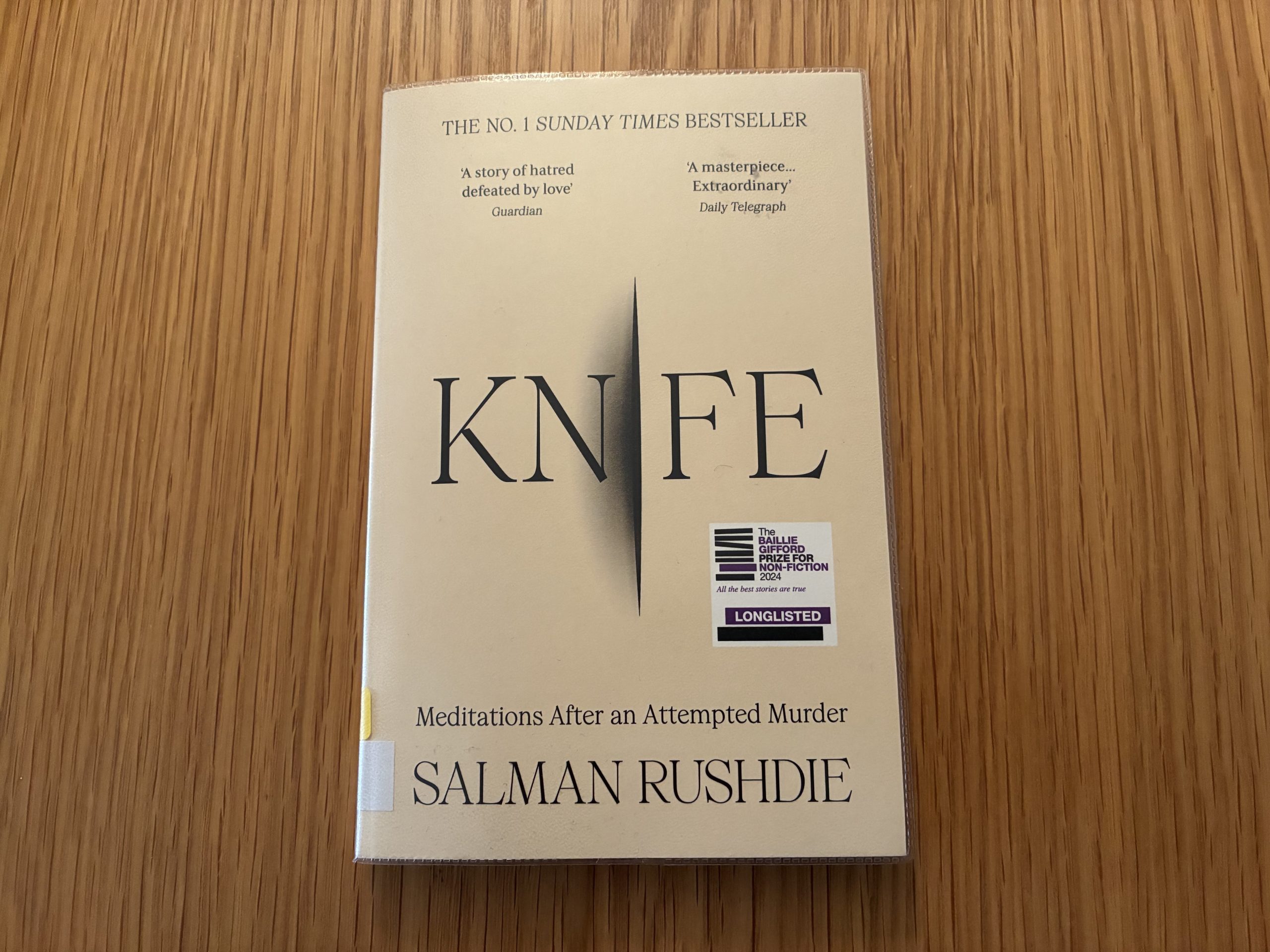
The memoir’s full title is Knife: Meditations After an Attempted Murder and opens just before Rushdie’s life is altered forever. He’s at the Chautauqua Institute in New York State in August 2022 for a conference that is devoted to safe spaces for writers. Ironic then that at the opening event, a man was able to run onto the stage and stab Rushdie fifteen times, including in his hand, abdomen and eye.
This awful attack was in response to a fatwa issued by the Iranian leader five months after the publication of Rushdie’s novel The Satanic Verses in September 1988. Albeit his attacker, who in Knife is referred to only as ‘A’, had only read a few pages of the book. For years, after the fatawa, Rushdie lived in hiding with protection from the UK security forces. But in 2000, he moved to the US, and for more than 20 years, life had been fairly normal. Until that fateful day.
Knife covers the hours immediately following the attack, describing the life and death situation Rushdie faced, before moving on to his recovery. Some of the descriptions of his injuries are very vivid. He describes his damaged eye as “hugely distended, bulging out of its socket and hanging down on my face like a large soft-boiled egg”. Little wonder his wife kept him away from a mirror for an extended period of time.
Thirty years his junior, Griffiths, is devastated by the attack and by his side throughout his recovery. She’s described as the soulmate he was always looking for. Though there’s a rather odd section in Knife which seems pretty disparaging and disrespectful to some of his earlier partners. He says his younger son and others commented, “Finally”, after meeting Griffiths. She responded by getting t-shirts made for Rushdie with the word printed on them. Feels like he could have kept that anecdote off the page.
Despite the detail of the attack and recovery sometimes making me wince, I found it to be the best part of the book. Later in the narrative, Rushdie becomes more philosophical, ruminating on art and freedom and contemplating the appearance of knives in art. Then he wonders why so many of his friends (famous names like Martin Amis, Paul Auster and Hanif Kureshi) are also facing down death, albeit for different reasons.
There is also what I felt to be the strangest part of Knife, where Rushdie recounts an imaginary conversation with his attacker. He can’t actually talk to A, so he fictionalises a conversation using information he’s learned about him. I guess it was all part of coming to terms with what happened and trying to understand why A attacked him. But it’s a lengthy exchange that I felt didn’t really add substantially to the book.
Having said that, Knife is a relatively short book at 224 pages, and I think it’s worth reading for an insight into what it’s like to survive a near-death experience. It also gave me some insight into an author whose books have never appealed to me. In fact, only one member of my book club had read his work. And while none of us came away thinking we’d rush to pick up one of Rushdie’s lengthy tomes, we were pleased he survived to continue writing for those who do.
As with many of the books I read, I borrowed Knife from my local library, but it’s also available from bookshops, including the charity Oxfam, which is Europe’s biggest retailer of second-hand books. For more book reviews, visit the Books section of my blog.
Discover more from TRAVEL COCKTAIL
Subscribe to get the latest posts sent to your email.