Luxor is a must-do on any Egypt itinerary. The magnificent ancient temples on the city’s east bank and the stunning tombs on the west bank are some of the most extraordinary sights you’ll see anywhere in the world. And there is a lot to see. So my advice is to take your time rather than cramming it into a couple of days. And don’t feel you have to see every single thing on offer. Here’s how I did it.
Where to stay in Luxor
There are plenty of options for accommodation in Luxor and your first decision is whether to choose the east or west bank. Staying on the latter means you are close to the tombs in the Valleys of the Kings and Queens and can get a jump on the crowds.
The west bank is where you’ll find Karnak and Luxor Temple, as well as many more hotels, places to eat and shops. My friend and I opted for the Iberotel on the west bank, partly because we like being close to restaurants. But also because it was a fantastic place to have some downtime after nine days touring the country. It’s right on the Nile with gorgeous gardens and a swimming pool on a pontoon over the river. The morning view from our balcony was fab, as was lunch by the pool and the bread made in the hotel gardens. Perfect for a mix of sightseeing and relaxing during our time in Luxor.


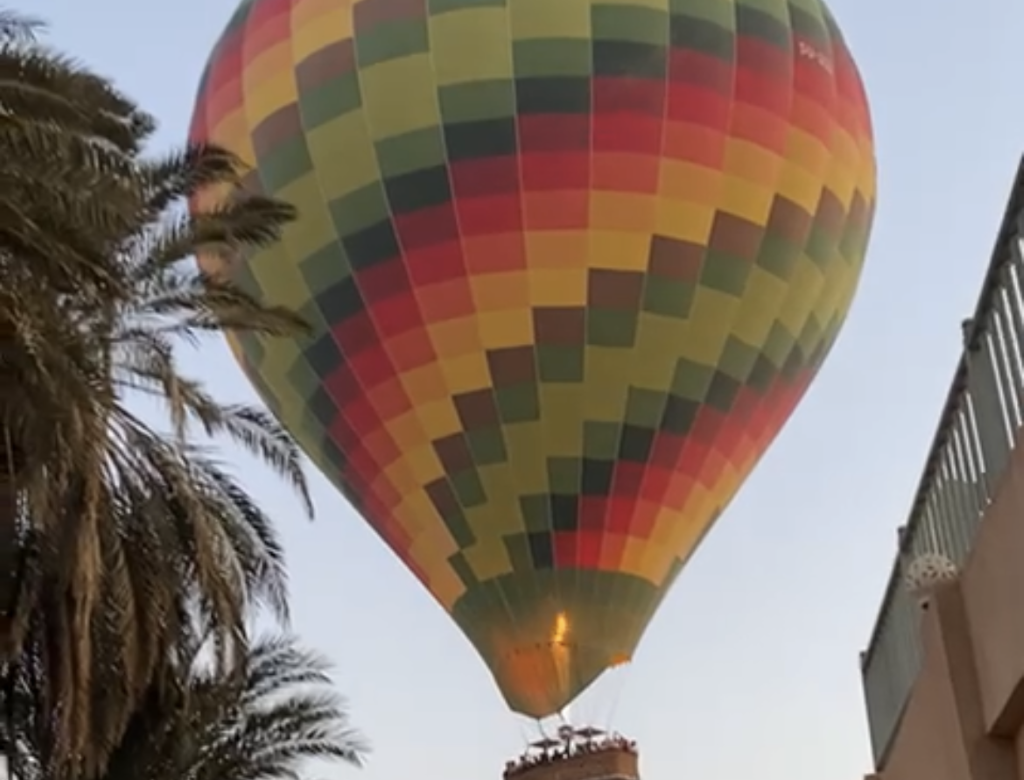
If we were awake early, we also had a good view of the hot air balloons rising over the west bank. From a distance we couldn’t see the colours. But a friend we met on a Dahabiya cruise stayed one night on the west bank and sent us a gorgeous close-up photo. Another friend from the cruise did a balloon ride and said it was good but chaotic. There are so many balloons taking off every morning that finding the right one can be a challenge!

 Visiting the Valley of the Kings
The limestone hills on the west bank of the Nile in Luxor are dominated by the peak of al-Qurn, a pyramid-shaped mountain that’s reminiscent of the pyramids of Giza. More than 60 tombs have been excavated in the hills, with many decorated with beautiful paintings and intricate reliefs.
 It’s a hot and tiring place to visit. So my advice is to book a driver and ideally a guide. From the west bank, the drive takes around 30 minutes. It’s quicker now as there is a new bridge crossing the Nile. Another option is to take a ferry across the river and hire a taxi once you are on the west bank. But you have to get to the ferry point and then negotiate with a driver on the other side, which we didn’t fancy doing early in the morning.
So we booked the private West Bank tour and lunch with Far and Beyond Travel. Our driver was great, and our guide Reem was brilliant. The company were also very flexible and happy to add an extra person to our tour at short notice (our friend from the dahabiya). Our pick-up was at 8.00am, so after picking up Susanna we were at the Visitor Centre before 9.00am, ahead of many of the bigger tour groups. Susanna was even able to snap a photo of myself and Miriam that looked like we had the whole place to ourselves!

 The Visitor Centre is where you buy entrance tickets, including for any extra tombs you want to see. Make sure to buy all the tickets you need. It’s the only place to get them, and from there you take a three-minute tram ride and a short, uphill walk to reach the entrances of the tombs. So you don’t want to go back. There are usually 12-14 tombs open, and it varies, so it’s best not to set your heart on seeing a particular one. There’s a list of 8-10 that is included with the standard ticket, and you can pick three to visit. Then there are others that you pay extra for.
Of these, we thought KV9, the Tomb of Ramses V & VI, was the best option. KV17, the Tomb of Seti I is said to be spectacular, but it is very expensive, and Reem advised us it wasn’t great value considering what you can see in other tombs. The Tomb of Tutankhamun, KV62, is another tomb you pay extra for. It’s the smallest you can visit in the Valley of the Kings, but when it was discovered in 1922, it contained the largest and most magnificent collection of artefacts. However, all of its contents are now at the Grand Egyptian Museum in Giza, and there is very little decoration in the tomb. So all you can see is the mummified body of King Tut and the burial chamber.
Tomb of Ramses V & VI (KV9)
Reem talked to us about the valley and its tombs, while sitting in shady seats in the cafe. Guides aren’t allowed inside the tombs, so we headed off and went into KV9 first because there was no queue. But we could have saved it for the end, as being one you pay extra for, there was rarely a big queue. And sometimes it’s good to save the best until last. It’s one of the largest tombs, featuring a very long hallway and several series of staircases. The decoration on the walls is incredible. When you see the colours and intricate carving, it’s hard to believe how old it is.


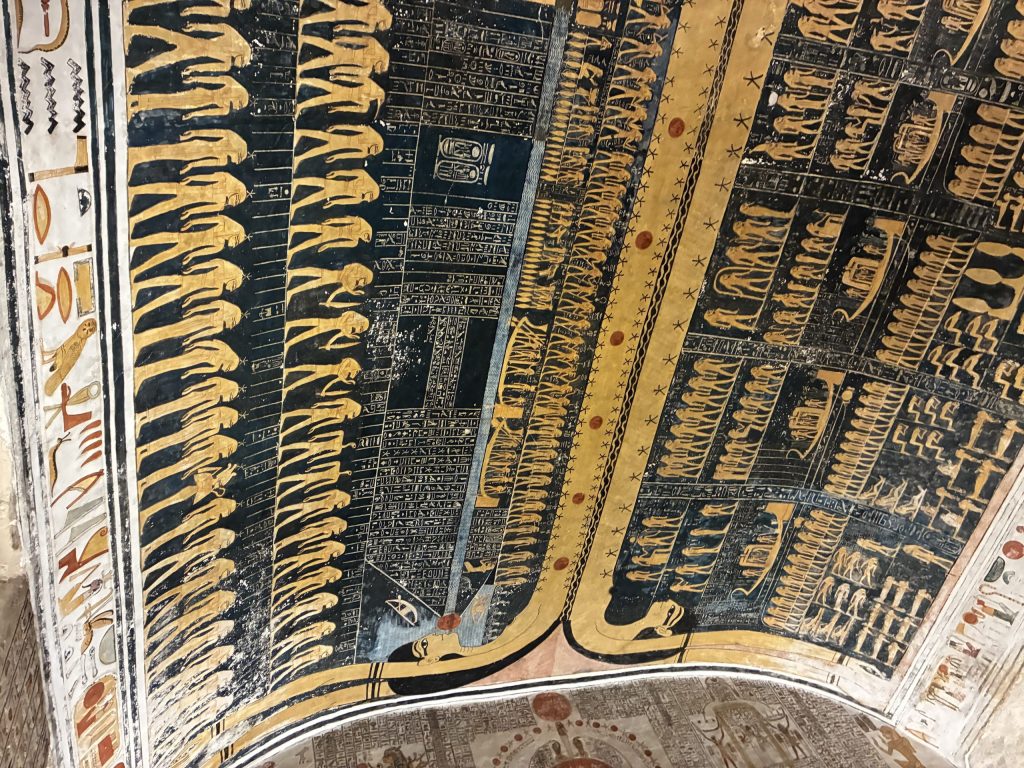
 Ancient Egyptians believed that Ra was the god of the living, who journeyed across the night sky to be reunited with Osiris, the god of the dead. Paintings on the ceiling of the KV9 tomb show this journey through the sky goddess Nut, who embodies the sky swallowing the sun at dusk and giving birth to it at dawn.
 Tomb of Ramses I (KV16)
Next we visited the Tomb of Ramses I, KV16, which was the hardest one to access, with a long staircase to the bottom. The walls aren’t painted, so after KV9 it seemed quite underwhelming. But at the bottom is a fantastic and colourful burial chamber.


 Tomb of Ramses III (KV11)
We chose KV11, Ramses III’s tomb next. He was the last of the great warriors, and his tomb is one of the largest in the Valley of the Kings. It was the best one we saw with the standard ticket. There are long passageways, with detailed artwork which is protected behind glass, that lead down to the burial chamber. There’s also a sudden change of direction inside as the builders nearly dug into a neighbouring tomb! The decoration is beautiful throughout, and there is a lot to see, including hieroglyphs with gilded birds and side chambers with scenes of pottery, weaponry and boats.

 Tomb of Ramses IX (KV6)
The Tomb of Ramses IV (KV2) was on the list that Reem recommended for us to visit. But it’s the closest to the entrance, which makes it one of the most popular. There was still a long queue as we made our way out, so we visited the Tomb of Ramses IX (KV6) instead. It’s another beautiful tomb and an easy one to access as there are no steps. Instead, you walk down a long, elaborately decorated passageway where you can see images from the Book of the Dead. The hallway ends at a viewpoint of the burial chamber.


Four tombs were enough for us at the Valley of the Kings. It’s quite overwhelming to take in what you’re seeing, as well as being hot both inside and outside the tombs. So we left happy with what we’d seen and our next stop on the tour was an alabaster shop. We’d heard that all the tours go to one and planned to say no thanks. However, Reem told us a good tale about the family who owned it, and we didn’t realise where we were headed until it was too late! But we didn’t actually mind going there for a free cold drink and a browse. We didn’t buy anything though as you can get similar products much cheaper at fair trade shops in Luxor.
Mortuary Temple of Hatshepsut
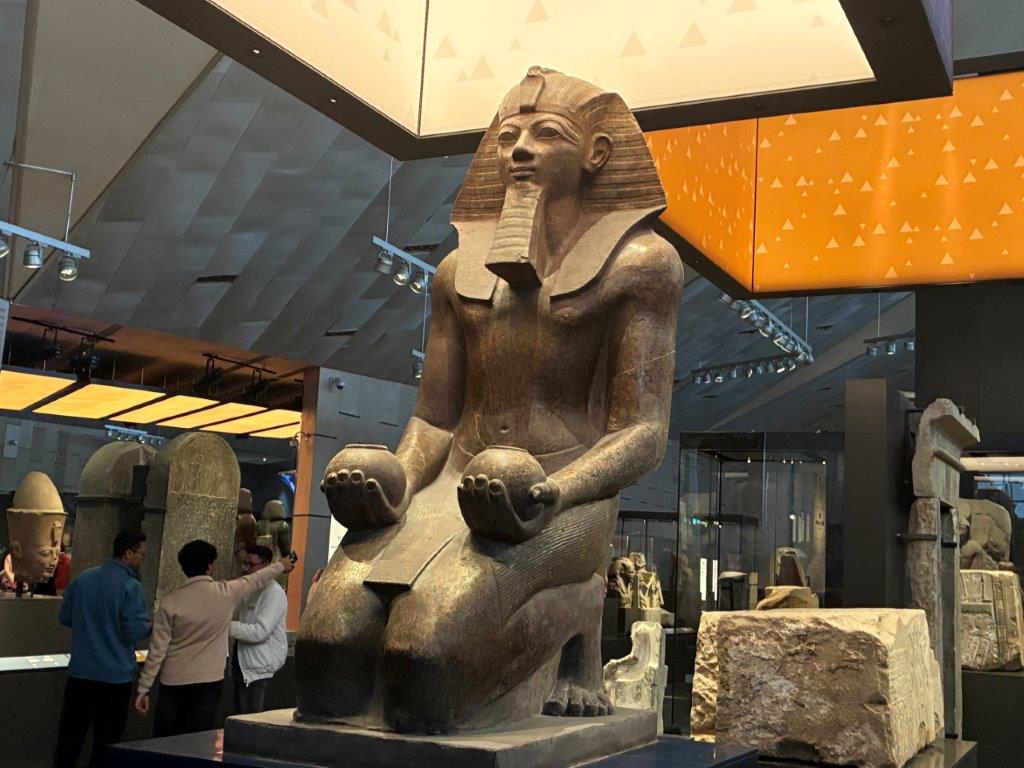
Our next proper stop was another must-do when in Luxor, the Mortuary Temple of Hatshepsut. We’d already heard quite a bit about Queen Hatshepsut at the Grand Egyptian Museum. She initially ruled as regent to her stepson, Thutmose III, who inherited the throne aged two. Several years later, Hatshepsut became a pharaoh and co-ruler alongside Thutmose III. But in the patriarchal Egyptian society, she had to take on male roles and was always depicted as a male pharaoh.
 Her mortuary temple is a huge, stylish structure with three large terraces that spreads out at the foot of cliffs. The temple has seen a lot of damage over time, including to some of the reliefs in the colonnades, but the huge statues of Hatshepsut are very impressive.


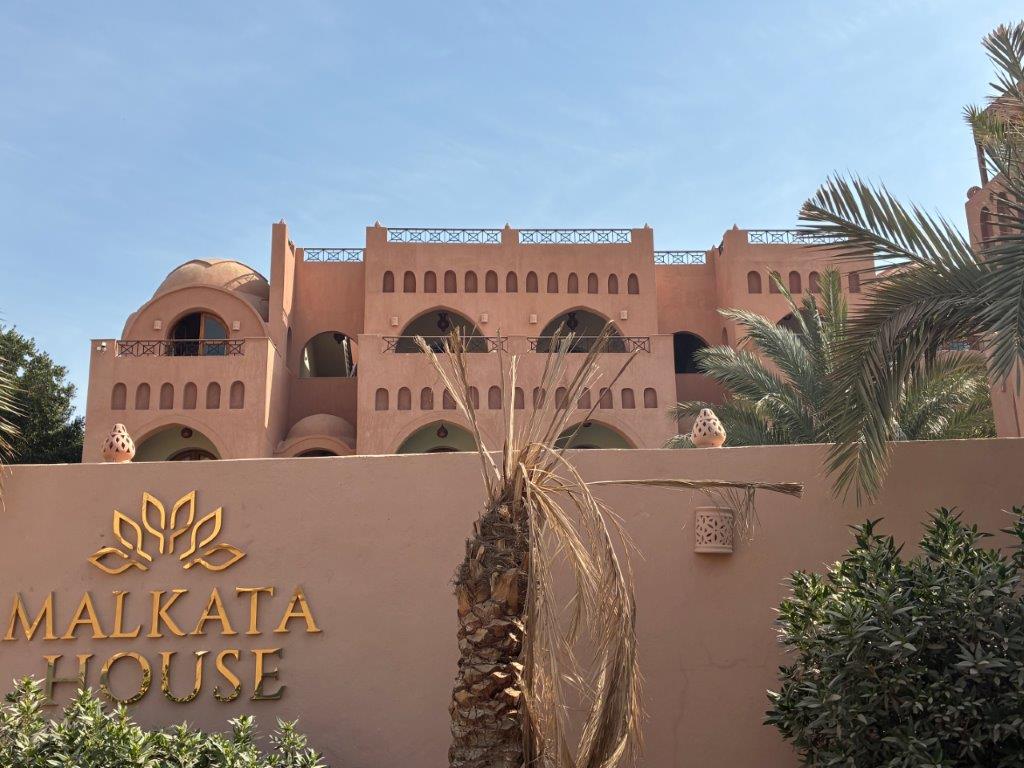
 After Hatshepsut, we had the option to visit Medinat Habu, the mortuary temple of Ramses III. At its height, the temple complex was the economic hub of ancient Thebes. But we knew it wouldn’t be as impressive as Luxor Temple and Karnak, which we planned to visit. So, as we were hot, tired and hungry, we chose to go straight to lunch on the rooftop of Malkata House. It’s a hotel that overlooks the Valley of the Queens. If you want to stay on the west bank, it looked like a lovely option, and the food was delicious.
 You can also book tours to visit the Valley of the Queens, which we originally thought we might do. But its most beautiful sight, Nefertari’s tomb, was closed. So we decided to book a tour of Luxor Temple and Karnak with Far and Beyond Travel and requested Reem as our guide. These are temples that you can get to quite easily if you’re staying on the east bank, and you could go without a guide. But in Egypt, we found we got a lot more out of a visit with a knowledgeable guide.
Karnak Temple Complex
Karnak is a spectacular complex of temples with massive monumental gateways (pylons) and magnificent hypostyle halls. It was built and expanded by many of Egypt’s great pharaohs over a 1500 year period. And is undoubtedly one of the most impressive sites in the country. Highlights include the avenue of ram-head sphinxes, the Temple of Ramses III (a mini version of Medinat Habu) and the huge columns that fill the Great Hypostyle Hall. Each column is designed to look like papyrus, which Ancient Egyptians believed surrounded the primeval mound on which life was created. In another hypostyle hall is the Obelisk of Hatshepsut, which at 30m is the tallest in Egypt, while its truncated pair is close to the Sacred Lake. So Karnak is another incredible ancient site not to be missed in Luxor. But we didn’t hear good things about the evening sound-and-light show. Evidently Karnak looks good lit up, but the commentary is not good!


Luxor Temple by night
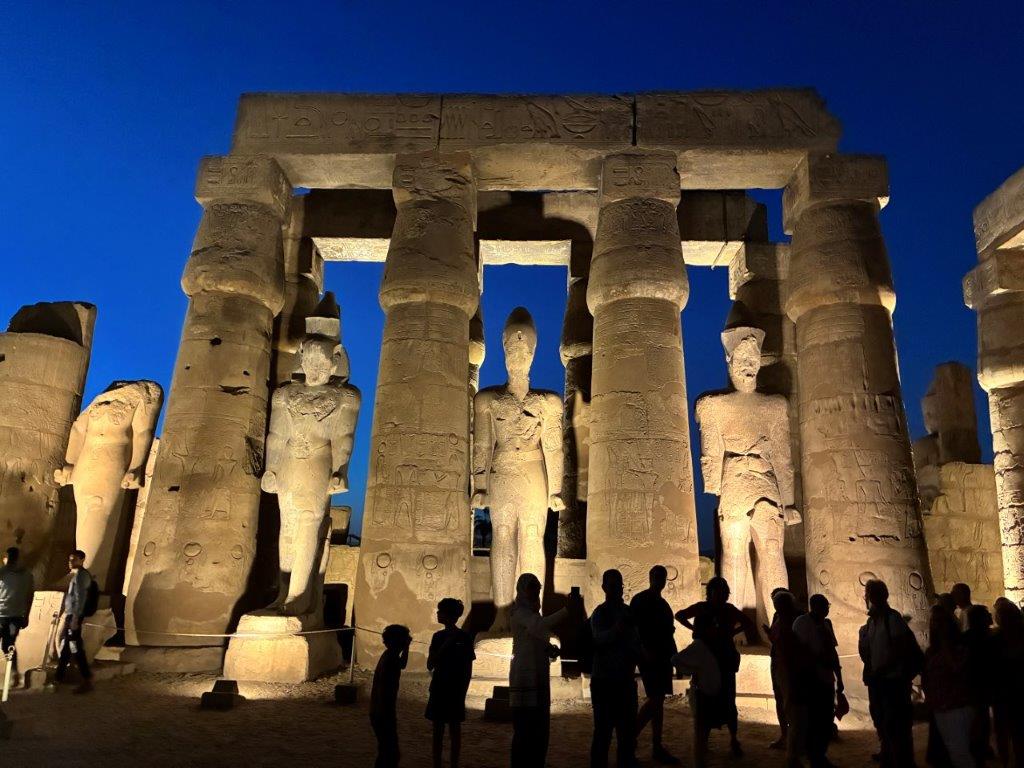
Unless you are staying near Karnak, Luxor Temple is easier to see illuminated as it’s central to the city. We went to Karnak mid-afternoon so we could be at Luxor Temple when the sun went down. And it is a stunning sight. When you see the huge beautifully lit pillars and statues, it’s easy to imagine yourself back in Ancient Egypt, albeit you won’t be alone. I think Luxor Temple is probably busy whatever time of day you visit. But the further away from the central part you go, the more the crowds thin out. Many people are in tour groups from big cruise ships, and they don’t stay very long. We even found the Avenue of the Sphinxes wasn’t very busy. The Avenue is a 3km long esplanade that runs all the way to Karnak. Access to it is included in the ticket for Luxor Temple and it’s car-free, so could be a nice daytime walk – if it’s not too hot!

 Where to eat in Luxor
In between visiting tombs and temples, you need to eat, and Luxor has plenty of options. One of our favourites was Al Sahaby Lane Restaurant, on the rooftop of the Nefertiti Hotel with a view of Luxor Temple. Both the Vegetable Tagine and Mushroom Feteer were delicious. Another good choice for local food is Restaurant El-Kababgy, which is right on the Nile. As with most Egyptian-run restaurants, neither of these serves alcohol, so the bill is very cheap!


For Western food (and alcohol), the Lantern Room Restaurant is good. It’s a bit further out of the centre so a cab might be a good idea. We used Uber in Cairo, but the main app in Luxor was inDrive. Some of the cars were pretty dodgy looking, so ok for short journeys but negotiating with a taxi driver outside your hotel might be better for longer trips. The hotels can also book a taxi, but they were always $US20, which was a crazy price considering how cheap Egypt is. But another good option for eating was in our hotel. It had three restaurants, and the bar also had a nice menu for lighter meals. I miss sitting on that bar’s terrace with a view of the Nile.
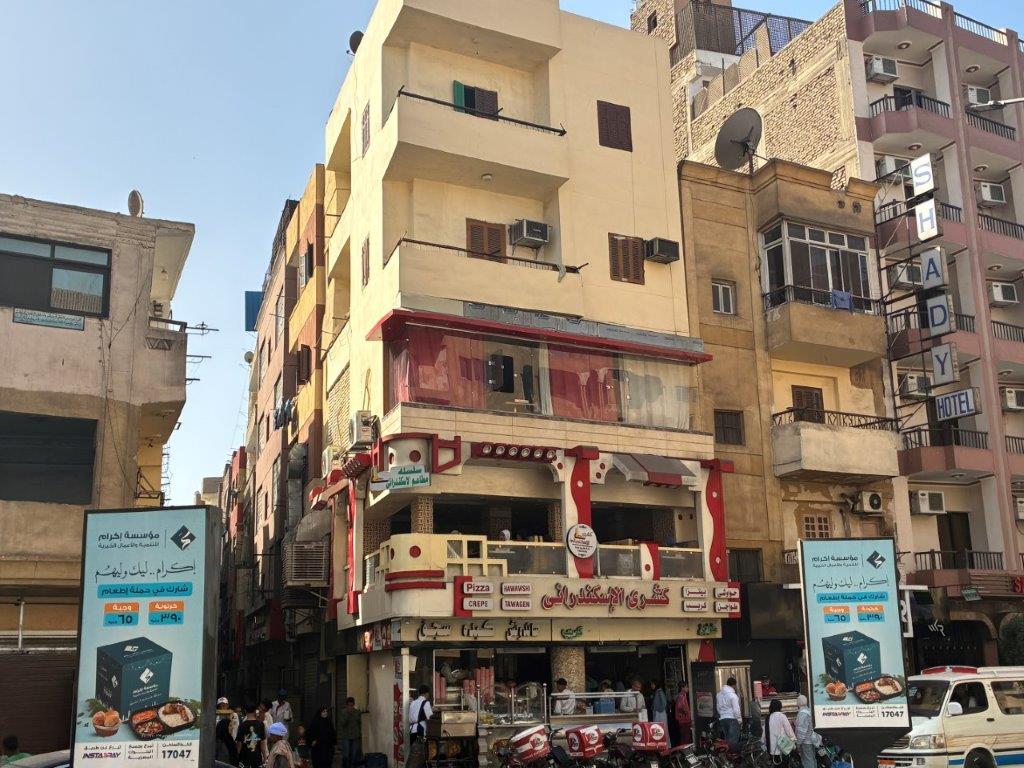
 For a very cheap meal away from the touristy area, Al Eskandari in Television Street is hard to beat. We had a very local koshary experience there and loved it. Koshary is the local ‘fast food’ that is made with macaroni, spaghetti, vermicelli, lentils, rice, chickpeas, and fried onions. It’s then topped with tomato sauce and a special garlic vinegar dressing called da’ah. Very filling and very cheap. You’ll also see some of the Luxor back streets in that area, which are quite different to the riverfront Corniche. We also found a great laundry in the back streets near our hotel, so it’s worth exploring.

 Where to shop in Luxor
Shopping in Egypt can be exhausting! Some of the stallholders near temples were very pushy, shoving t-shirts in your face as you walked by. And if you show any interest, the haggling starts, invariably with the seller starting at a ridiculously high price. We found it very wearing and off-putting, and in the Luxor Souk we only really engaged to buy an Egypt football shirt for my godson. Instead we sought out fixed-price and fair trade shops. Adel Estafanous in the souk makes and sells lovely fixed-price handmade scarves. Nearby Habiba Gallery is a fair trade shop that has a range of products from local artisans at fixed prices. We bought alabaster tealight holders that looked the same as ones that were offered to us for a much higher price at the west bank alabaster shop.


 We also found Basheet Drinks in the souk, which was one of the very few alcohol shops in the city. Despite that, they sold the local Omar Khayyam wine at a reasonable price. Imported drinks were expensive in Egypt, but we thought this local wine made from indigenous Bannati grapes was very good.
 So that’s how I spent my time in Luxor. As I said, there were other sights to see and places to visit, but if you don’t want to come away mentally and physically exhausted, I think just seeing a selection of what the city has to offer is plenty.
For more posts about my trip, visit the Egypt section of my blog.
Discover more from TRAVEL COCKTAIL
Subscribe to get the latest posts sent to your email.